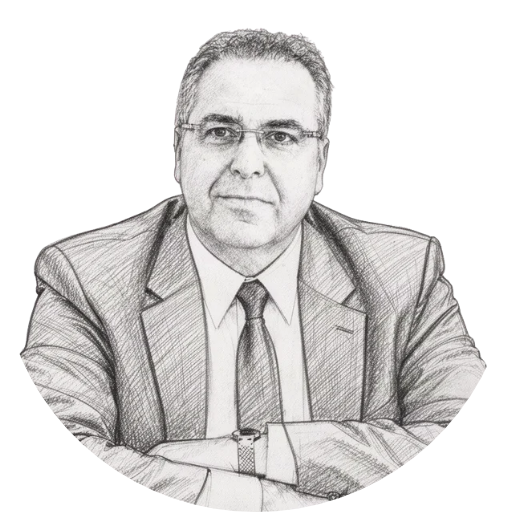
A documented philosophical study · 2026
A documented critical biography examining books, research, and translations in the context of modernity, exile, and Arab thought.
This text draws on published works, interviews, catalog records, and the sources listed at the end. Interpretive passages are presented as readings of the work, not statements attributed to the philosopher.
In this study
01 — An Introduction to His Intellectual Trajectory
02 — Formation: From Damascus to Paris
03 — Habermas and Derrida: A Test of Disagreement and Convergence
04 — Modernity as an Open Question
05 — Deconstruction and the Critique of Ready-Made Concepts
06 — The Stranger, the Self, and Exile
07 — Philosophy, Literature, and the Language of Writing
08 — The Migrant Logos and Arab Thought
09 — A Critical Return to Habermas
10 — Translation and Research in 2026
11 — Syria, Politics, and the Concept of Citizenship
12 — The Contours of an Open Philosophical Project
13 — His Place in Contemporary Arab Philosophy
An Introduction to His Intellectual Trajectory
Khaldoun Al-Nabwani belongs to Arab thinkers whose questions arose in multiple languages and contexts. From Damascus to Paris, he began by reading the dispute over modernity in European philosophy, then returned to question the concepts of identity, alienation, translation, and the position of Arab thought in this dispute. In this journey, Habermas and Derrida appear not only as names in the history of ideas, but as two conflicting gateways to the questions of reason, difference, and politics. [1] [2] [3]
This file sheds light on Al-Nabwani’s published works, excerpts, research articles, bibliographic materials, and available critical readings, concluding that his work strives to test concepts as they transition: from theory to practice, from one language to another, and from an individual experience of exile to a general question of alienation. Thus, this is a reading of an evolving trajectory, rather than a complete system of thought attributed to him. [4] [5] [9] [13]
Formation: From Damascus to Paris
Al-Nabwani studied philosophy at the University of Damascus, graduating in 1999 according to the bio published in an extended interview with him. He moved to France at the beginning of 2004, continuing his studies in Paris in the Contemporary Philosophy Master’s program at University of Paris 1 Pantheon-Sorbonne that same year. French thesis records note his defense of a Ph.D. in Philosophy at the University of Paris 1 on June 28, 2013, supervised by the philosopher of law Jean-François Kervégan, titled “Habermas and Derrida: Theoretical Divergence and Practical Convergence?”. These are direct university data that place the focus of his early interest in its proper place.[2] [3]
Residing in two cities is not enough to explain an intellectual project, but it explains some of its conditions: the philosophy he received in Arabic in Damascus later became the subject of writing and research in French, and then he re-acquired its questions in Arabic. Connected to this is his subsequent preoccupation with translation, and with the shifts that a concept undergoes when it changes its language, audience, and political context. Subsequent introductory materials mention his work teaching political philosophy in Paris, and his university degree enrollment and the documentations of his books and researches can also be verified. [1] [2] [3] [4]
The subject of his dissertation derives its strength from a specific paradox: how were Habermas and Derrida, differing on rationality, modernity, and the language of philosophy, able to converge in addressing certain issues of politics, international law, and the future of Europe? That question about the limits of theoretical disagreement and the possibility of joint action would remain present in aspects of his subsequent writings. [3] [5] [6]
Habermas and Derrida: from Disagreement to Convergence
His French book L’ambivalence de la modernité: Habermas vis-à-vis de Derrida, published in 2017 by L’Harmattan in Paris, reconstructs the 1980s debate between a philosophy defending the incomplete project of modernity and a deconstructive critique calling its foundations and vocabulary into question. The publisher’s page clarifies that the book starts from Habermas’s critique of Derridean deconstruction and the German-French debate on postmodernity. It is an independent work of 296 pages, not to be confused with the thesis that preceded its publication. [3] [5]
In his French research “The Future of Europe, a Project that Reconciled Habermas with Derrida”, Al-Nabwani studies the transition of the relationship between the two philosophers from an intellectual confrontation to convergence on certain positions regarding the future of Europe and the world. This does not entail denying the original disagreement; rather, it requires separating two types of questions: the question of philosophical foundations, and the question of political decision in a specific historical circumstance. When Al-Nabwani reads this movement, he turns the relationship between the two philosophers into an test of the possibility of difference without interrupting dialogue.[6]
He returned to the same material in his book Ambivalences of Modernity published in Arabic in 2022. Published excerpts of the book show that it does not start from the moment of rivalry alone, but traces the transformations of the thinkers and what they inherited from 20th-century debates. An independent critical reading argued that the Arabic version recomposes and expands the topic rather than merely providing a literal translation of the French book; which is a critical testimony about the book, not a description to be generalized without examining both versions fully. [7] [8]
Modernity as an Open Question
An early point in this trajectory appears in his book Aporias of Modernity and Postmodernity published in 2011 by Dar Al-Mada in Beirut. It compiles researches, studies, and articles on the problems of modernity and postmodernity, linking theoretical philosophical thinking with practical and political questions raised by humanity. Al-Nabwani does not treat the word “modernity” as a self-sufficient answer; the most important question remains what modernity promises, and what contradictions arise from within its own promise. [10]
The conflict between Habermas and Derrida was a specific way to approach this broad question. Habermas sees the possibility of reforming the modern project through communicative rationality and public discourse institutions; while deconstruction reveals how exclusions and hierarchies infiltrate seemingly neutral language. The reading here does not equate the two philosophers nor reduce either to a slogan, but highlights why the comparison between them became a recurring axis for Al-Nabwani. [3] [5] [7]
In his peer-reviewed study published in the journal “Tabayyun” in 2026, the center of gravity shifts from defining postmodernity in its primary home to exploring how it was received in the Arab world. The abstract distinguishes between philosophical postmodernity, particularly French, and artistic postmodernity, which took shape differently in the United States. It discusses the impact of French language and culture in the reception of Maghrebi thinkers, versus the presence of nationalist and Marxist currents in part of the Mashreq. It is a hypothesis raised by the research concerning the disparity of reception, not a law explaining every Arab thinker individually. [13]
Deconstruction and the Critique of Ready-Made Concepts
Deconstruction, in Dr. Al-Nabwani’s reading, is not a ready-made recipe to invalidate every meaning. His dialogues and lectures reveal an attempt to uncover the assumptions that precede the use of grand words: homeland, the self, secularism, religion, identity, the intellectual, and democracy. The word becomes a subject of research when we ask what it includes in its meaning, who it excludes, and what changes in it according to the speaker’s position. [11] [12]
Therefore, the connection to Derrida does not mean he declares allegiance to a single philosophical school. In an extended dialogue, Al-Nabwani links the act of questioning to a broader history of skepticism toward appearance and the familiar, summoning multiple names in critiquing social and cognitive structures. It is more appropriate to read this connection as a sharing of a critical sensitivity, then examining in each text where the writer follows previous tools and where he modifies them to serve his subject. [11] [12]
The difficulty of this method lies in the fact that skepticism toward concepts can turn into a new generality if the writer does not clarify the texts and events on which he tests his concepts. For this reason, the most convincing pages of the project appear when deconstruction is linked to a tangible subject: the debate on Europe, the experience of exile, the record of philosophical Arabic, or the reception of a European idea in an Arab environment. [5] [9] [13]
The Stranger, the Self, and Exile
The book “The Stranger: Philosophical Reflections and Dialogues on Politics, Exile, and Alienation”, published in 2023, turns personal experience into material for thought. The index records that it includes philosophical-political texts on exile and asylum, followed by dialogues conducted with the author over previous years. The book itself describes in its introduction—as the index conveys—as a veiled autobiography hiding within ideas and political preoccupations. The book does not narrate a sequential life as much as it rebuilds the position of the person narrating it.[9]
Alienation in these pages is understood on overlapping levels. There is a separation from place and residency rights, there is a distance from language, customs, and the inherited image of the homeland, and another distance may arise between a person and what they thought was a fixed self. Therefore, to the extent that “the stranger” becomes a name for a person, on the one hand, it becomes an experience and an existential philosophical question at the same time, which perhaps explains Al-Nabwani’s coinage of the word “êtrenger” to express the stranger. Readings of the book noted that it opens a discussion on alienation in Syrian and Arab society through biography and dialogue. [9] [14] [15]
This trajectory leads to a non-closed conception of identity: ancestry, passport, or language are not enough to explain what an individual experiences of belonging. However, the fluidity of identity is not an erasure of its history or its owners’ rights; critically testing the concept must maintain its connection to the material and political conditions that make exile forced or a choice and determine who possesses the ability to speak within it. [9] [15] [16]
Philosophy, Literature, and the Language of Writing
In Philoliterary Texts (2017), al-Nabwani seeks to release philosophical writing from a single academic model of demonstration. Before the book appeared, he wrote an essay on the meeting of literature and philosophy, arguing that their boundaries are harder to separate than conventional classifications suggest. This does not mean that every rhetorical figure becomes a philosophical argument; imagination, rhythm, and narrative may nevertheless do conceptual work. [4] [17]
This attempt drew a direct critical response from the philosopher Ali Harb, the pioneer of deconstruction in the Arab world, who discussed Al-Nabwani’s success in writing a philosophical text in the Arabic language, but objected, among other things, to the compound word “أدبفلسفية” (Philoliterary ) which appeared in the title. The presence of such an objection is important for reading the work; it reveals that the issue is not merely stylistic aesthetics, but the legitimacy of the term, its derivation method, and the capability of Arab philosophy to invent new forms of expression.. [18]
When talk of “Logos” appears in his later works, the connection of that early experience to a larger project becomes clear: that philosophy should not be confined to a technical language that expels poetry and rhetoric from the realm of thinking. We may disagree with this expansion, but viewing it as an organizing principle for his writing explains why some of his texts sometimes approach the contemplative essay, autobiography, and dialogue. [12] [17] [19]
The Migrant Logos and Arab Thought
Migrant Logos: Deconstructive Readings of the Arab Nahda, Enlightenment, and Modernity, published in 2025, combines the question of language with the question of civilizational location. In his introduction to the book, Al-Nabwani says that his choice of the expression “Migrant” came after thinking about other descriptions, and that the intention is not to judge Arab reason as deficient, but to question its confidence in its ability to produce philosophical discourse. A press review conveyed his vision of a logos where rhetoric and poetry border on proof and logic. [19] [20]
If an idea migrates from one language to another, it does not arrive intact and neutral as it left, since its uses change when translated, and it receives objections stemming from a different history. Therefore, the book allows reading the Arab Renaissance, Enlightenment, and Modernity as sites of engagement with concepts that migrated into Arabic, rather than mere tests of the extent of imitation of a European experience. This is an analytical summary of the book’s orientation as revealed from its title, introductory material, and its author’s interviews, and not a quotation from its text. [19] [20] [21]
Here a productive paradox emerges in Al-Nabwani’s own trajectory: he was formed through research in the French-German debate, then transformed that debate into Arabic to become a subject of examination. This paradox is useful in explaining the centrality of translation for him; he uses the term coming from outside Arabic, but questions the conditions of its reception and the possibility of its reformulation. [4] [13] [19]
A Critical Return to Habermas
Dr. Al-Nabwani’s relationship with Habermas does not end with his first thesis. In “Conservative Modernity: Critical Readings in Habermas’s Ideas”, published in 2024, he addresses stages of Habermas’s philosophy subsequent to the theory of communicative rationality. The book’s description mentions his work on practical philosophy, and a quote from its introduction shows that he did not address all his discussions, including certain issues of bioethics and naturalism. This limitation set by the author on the scope of his work prevents portraying the book as a final judgment on Habermas’s entire project. [22]
‘The word “Conservative” in the title deserves a careful reading; it describes a critical angle in viewing communicative rationality’s ability to change reality, not a simple judgment on the German philosopher’s entire political career. In a 2019 interview, Al-Nabwani expresses explicit remarks on what he considers the coldness of certain philosophies reconciled with the modern world. One can see here a growing critical distance from his study subject, not a rupture that nullifies the cognitive benefit he derived from reading him. [21] [22]
Translation and Research in 2026
Translation played an actual role in building this path. Al-Nabwani translated and introduced Giovanna Borradori’s Philosophy in a Time of Terror: Dialogues with Jürgen Habermas and Jacques Derrida, published in Arabic by the Arab Center for Research and Policy Studies in 2013. Publishing records also prove the translation of Frédéric Lenoir’s Happiness: A Philosopher’s Guideand and Jostein Gaarder’s The Solitaire Mystery. A distinction must be made between these translations and the works written by Al-Nabwani under his own name. [4] [23] [24]
In 2026, the question of Arab reception takes a direct research form in the article “The Arab Reception of Postmodern Philosophy: Between the Myth of Historical Linearity and the Metaphor of Fire” (published in “Tabayyun”, Vol. 14, No. 55, pp. 65–90, with a registered DOI). Its value within this trajectory is that it shifts attention from the history of the European idea to the history of its reading in Arabic, making the disparity of language media and intellectual institutions part of the explanation. [13]
The same year was associated with a work of a different nature, as Khaldoun Al-Nabwani edited and introduced the book Modernity in the Thought of Youssef Salamah, gathering materials from the Palestinian-Syrian philosopher’s archive, and in the same year published his work My Teachers: Readings and Testimonies in the Works of Sadiq Jalal Al-Azm and Youssef Salamah. Both works open a door to contemplating the impact of teachers and intellectual memory in the author’s formation. However, it is worth noting here the difference between the two works: the first book is edited and introduced by Al-Nabwani on Salama’s thought, while My Teachers is his book reading his two pfroessors and testifying for them. [25] [26] [27]
Syria, Politics, and the Concept of Citizenship
Al-Nabwani’s philosophical writing was not far from Syria. Some institutions mention his participation in political debate after 2011, and his published articles indicate an interest in intellectual-political questions such as citizenship, hospitality, exile, and the relationship of groups with one another. However, an immediate political stance is one thing and philosophical analysis is another; fairness requires reading his arguments in their texts rather than reducing them to organizational affiliation or media appearances. [1] [2] [16]
The Syrian experience in this aspect functions as a test: what does the state mean when it does not protect its citizens? How does a sect or identity turn into a comprehensive explanation behind which the individual disappears? And what does hospitality mean when the refugee becomes legally and socially a stranger? These questions are present in his titles and interviews, connecting the themes of “The Stranger” to his political philosophy themes. [9] [16] [21]
The intellectual benefit of this connection pursued by Al-Nabwani is that political vocabulary is not used as if its meaning were agreed upon in advance. Yet this strategy also places the writer before a difficult test: every critique of identity must clarify the impact of power, institution, and law on the lives of their owners, otherwise it remains a linguistic critique far from reality. This is an evaluative remark on the method of reading, not a stance on a specific Syrian issue. [9] [16]
Features of an Open Philosophical Project
Features of an Open Philosophical Project
The general movement in Khaldoun Al-Nabwani’s output can be arranged in four overlapping directions: researching modernity and postmodernity, examining the dispute between Habermas and Derrida, shifting the question to the experience of exile and identity, and then questioning the circulation of concepts within Arab thought. These are not closed stages; he returned to Habermas after publishing “The Stranger”, and political and literary questions remained present in more than one book. This arrangement is useful in reading as long as we do not turn it into an illusory linear biography. [5] [9] [13] [19] [22]
The most prominent strength in this path is linking difficult philosophical debates to tangible problems for the Arab writer: how do we name exile? Can Arabic produce a concept from its experience? And what remains of the European dispute when read from a different experience? Translations, peer-reviewed studies, and literary and philosophical books show an ability to move between types of writing and diverse audiences. [13] [17] [19] [23]
The remaining critical question is the degree of conceptual independence of this project. Al-Nabwani presents vocabularies and reading methods of a personal character, but judging that he founded a philosophical school or a new system is still premature. This project needs to develop the use of concepts in complete texts and a broader critical reception. To be more precise, Khaldoun Al-Nabwani can be described, based on what has been published, as the owner of an open philosophical project that transforms into a general existential question in the subjective, and in which the idea is formed from an open dialogue with those he reads and disagrees with. [18] [21]
His Place in Contemporary Arab Philosophy
Al-Nabwani writes from a dual position: the experience of early Arab formation and research work in France, and participation in European philosophy debates and reading them in Arabic. This duality is not exclusive to him alone, but his works make it a subject for philosophical thinking rather than considering it mere information in a biography. Therefore, the vocabularies of translation, migration, the stranger, identity, and logos recur in him in divergent subjective and research formulas. [2] [3] [9] [19]
The distance narrows between describing him as a researcher on Habermas and Derrida and the question of whether he has become a bearer of a distinct philosophical voice. His dissertation and early books prove the seriousness of engaging with the history of philosophy and the rigor of academic work in him; but his recent books such as “The Stranger” and “Migrant Logos” and the attempt at philosophical-literary writing in “Tabayyun” grant clearer features of his philosophical independence and provide a clearer space for formulating his own language and questions. Ali Harb saw this when he pointed to Al-Nabwani’s success in writing a philosophical text in Arabic. Perhaps this interaction from Ali Harb shows how the reception of his project itself became a subject of debate and exchange. [3] [9] [18] [19]
The book My Teachers” allowed him to reclaim Sadiq Jalal Al-Azm and Youssef Salamah as part of his cognitive formation. The value of this work differs from the comparison with European thinkers; it adds an announced Arab intellectual lineage to the record of his books. Thus, the reader reads his transition between two philosophical spaces as a relationship of dialogue with masters, texts, and experiences, rather than a simple division between East and West. [26] [27]
Selected Remarks
‘Citizenship is the primary basis of belonging; all the rest belongs to the sphere of private freedoms.’ [2]
Interview published by the Arab Center for Contemporary Syria Studies
‘Only persevering and determined work, without surrender or despair, makes them possible.’ [2]
On the possibility of realizing justice and democracy, in the same interview
‘The mask of reason was the Trojan horse by which poetry entered the realm of philosophy.’ [17]
‘The Literary–Philosophical Text’
Conclusion
Conclusion
Dr. Khaldoun Al-Nabwani’s trajectory illustrates how a specific academic question can expand without losing its seriousness and philosophical power. The thesis began from the theoretical divergence and practical convergence between Habermas and Derrida; and branching from them was a reading of concepts on the borders of modernity, exile, language, and politics. Then the Arab thought’s reception of modernity and postmodernity became an authentic part of the question itself. [3] [5] [13]
Therefore, the metaphor of “Migrant Logos” appears as more than a book title in this reading: it is an image of an idea migrating, acquiring during its transit another ability to reveal its limits. The strength of the image is contingent upon what it produces in terms of analyzing specific texts and events. In this distance between the idea and its journey lies perhaps Khaldoun Al-Nabwani and his ideas. [13] [19] [20]
Sources
Citation numbers in the study refer to this list. Translated work titles are supplied for readers and may differ from the original publication titles.
Home · The study · Works & sources · About · Articles

